
How the battle for liquid resources forged the economic identity of Bakersfield and the southern San Joaquin Valley.
From Arid Wilderness to Irrigation Pioneers
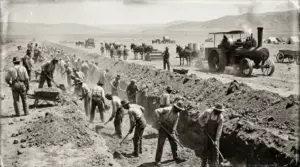
Long before steam tractors and steel pipelines dominated the valley, the natural hydrology of the region was dictated by the Kern River. Tumbling down the southern Sierra Nevada, the river spilled onto the valley floor, feeding a complex, shifting network of sloughs, marshes, and seasonal wetlands like Buena Vista Lake. While rich in wildlife and historically sustained by Indigenous Yokuts communities, the landscape was violently unpredictable—oscillating between devastating floods during spring snowmelts and searing, bone-dry droughts.
As settlers arrived in the mid-19th century—cemented by figures like Colonel Thomas Baker, who began reclaiming the Kern Delta—they quickly realized that mastering the water meant mastering survival. By the 1860s and 1870s, pioneers began gouging out primitive irrigation ditches by hand, diverting river flows to feed early alfalfa, grain, and cattle ranches. What followed was an aggressive era of canal building, transforming local creeks into systematic arteries like the Kern Island Canal.
The Clash of Titans: Agriculture Meets the Oil Boom
If taming the river was a monumental challenge, the dawn of the 20th century threw an entirely new variable into the equation. The 1899 discovery of oil near Oildale triggered a frenzied petroleum stampede. Suddenly, thousands of roughnecks, investors, and speculators flooded the region. Derricks sprouted like an artificial forest across the hills, and towns materialized overnight.
This rapid industrialization placed an unprecedented demand on local resources. Drilling operations, refineries, and expanding boomtown populations required massive amounts of water. Concurrently, large-scale farming syndicates were expanding their acreage, demanding every drop of river runoff to sustain crops under the relentless Central Valley sun. This friction birthed legendary legal battles over water rights—pitting powerful land barons, agricultural cooperatives, and oil conglomerates against one another in protracted courtroom showdowns that redefined California water law.
Engineering the Future: Aqueducts and Artificial Rivers
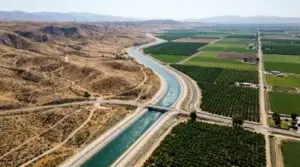
By the mid-20th century, local groundwater basins were under severe stress, and local surface water supplies were stretched to their absolute limits. The post-war economic boom demanded a structural solution on a continental scale. Enter the massive state and federal water projects that permanently altered California’s geography.
The construction of the California Aqueduct introduced a new chapter of abundance and controversy. Transporting water hundreds of miles from Northern California across the formidable barrier of the Tehachapi Mountains, this colossal system of concrete channels, pumping plants, and siphons injected a secondary lifeblood into Kern County.
Agriculture scaled to unprecedented industrial levels, producing global yields of almonds, grapes, citrus, and cotton, while the oil industry continued its deep-extraction processes. However, this engineering triumph came with hidden ecological trade-offs, contributing to long-term groundwater management dilemmas and land subsidence issues across the valley floor.
Legacy of the Liquid Lifeline
Today, when looking across the sun-lit expanse of Kern County, the visible markers of its dual heritage are everywhere. Massive distribution canals run parallel to pumping oil wells, an everyday visual reminder of how two contrasting industries were forced to co-exist in an unforgiving climate.
The evolution of Kern County’s irrigation and water network is a testament to human ingenuity coupled with perpetual environmental adaptation. As the region navigates modern sustainability goals, changing climate patterns, and shifting economic landscapes, the ghosts of the early water wars remain a vital lesson: in the southern San Joaquin Valley, water has always been, and will always be, the ultimate currency.